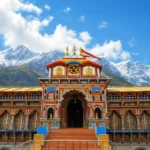
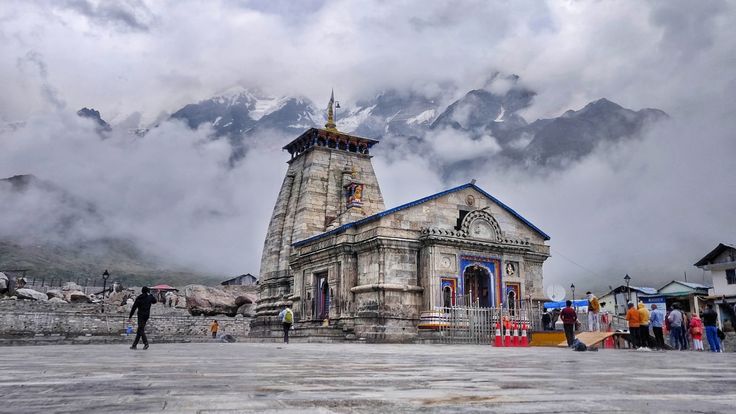
Kedarnath Dham is one of India’s most spiritually charged Himalayan shrines, serving as the highest of the $12$ sacred Jyotirlingas and a core pillar of the sacred Char Dham pilgrimage. Tucked away in the snow-capped mountains of Uttarakhand, it represents the ultimate destination for seekers of Lord Shiva’s divine grace.
🏔️ Kedarnath Dham: Quick Facts & Overview
| Aspect | Details |
|---|---|
| Primary Deity | Lord Shiva (Revered as Kedarnatha / Lord of the Field) |
| Location | Rudraprayag District, Uttarakhand, India |
| Key Significance | Highest of the $12 \text{ Jyotirlingas}$ and part of the Panch Kedar |
| Opening Season | Akshaya Tritiya (April/May) to Bhai Dooj (October/November) |
| Trek Distance | Approximately $16\text{ to }18 \text{ km}$ from Gaurikund base camp |
| Best Time to Visit | May to June, and September to October |
| Winter Seat of Deity | Omkareshwar Temple, Ukhimath |
⚡ Quick Read: Essential Highlights
- The Legend: Built originally by the Pandavas seeking atonement, and later revived by Adi Shankaracharya in the
$8\text{th century AD}$. - The Miracle: Survived the devastating
$2013$Himalayan flash floods unscathed, protected by a massive boulder called the Bheem Shila. - The Journey: Requires a scenic but challenging
$16\text{ to }18\text{ km}$mountain trek starting from Gaurikund, or a quick helicopter ride from lower base camps. - Best Time: Visited primarily during the summer (May–June) and autumn (September–October) months before heavy winter snow sets in.
📜 Sacred Legends & Historical Origins
The history of Kedarnath is a magnificent tapestry woven with ancient Vedic stories, Mahabharata legends, and historical accounts of revival.
1. The Pandavas and the Quest for Atonement
According to Hindu scriptures, after the cataclysmic Kurukshetra War, the Pandava brothers were deeply distressed by the guilt of Gotra-vadh (slaying their own kinsmen, the Kauravas) and Brahma-hatya (killing teachers and sages). Sage Vyasa advised them that only Lord Shiva could absolve them of these sins.
The Pandavas traveled to Kashi (Varanasi), but Shiva, wishing to avoid them because of his anger over the war’s violence, disguised himself as a bull and fled to the Garhwal Himalayas. The Pandavas followed him to Guptkashi. There, Bhima spotted a unique bull grazing among a herd and recognized it as Shiva.
To escape, Shiva began diving headfirst into the earth. Bhima quickly grabbed the bull by its tail and hind legs. Although Shiva disappeared into the ground, his triangular hump (Pind) remained on the surface at Kedarnath and solidified into stone.
The other parts of the divine bull manifested at four other locations in the region:
- The Hump: Kedarnath
- The Arms (Bahu): Tungnath
- The Face (Mukh): Rudranath
- The Navel (Nabhi): Madmaheshwar
- The Hair (Jata): Kalpeshwar
Together, these five sacred sites are celebrated as the Panch Kedar, with Kedarnath being the foremost.
2. Revival by Adi Shankaracharya
Over the millennia, the original temple built by the Pandavas fell into disrepair due to the harsh Himalayan climate. In the $8\text{th century AD}$, the legendary philosopher and theologian Adi Shankaracharya arrived in Kedarnath. He rebuilt the temple using massive, precisely cut interlocking stone slabs, placing a grand idol of Nandi outside and establishing the sacred rituals that are followed to this day. Shankaracharya took his Samadhi (final liberation) right behind the Kedarnath Temple at the tender age of $32$. His restored Samadhi site and statue are major points of reverence today.
🪨 The Miracle of the Bheem Shila and the 2013 Floods
In June $2013$, a catastrophic cloudburst over Uttarakhand triggered a massive glacial lake outburst of the Chorabari Lake, located just upstream from the temple. A torrent of water, mud, and colossal boulders rushed down the mountain slopes, wiping out entire townships, hotels, and paths in the Kedarnath Valley.
While everything around the temple was decimated, the main shrine survived virtually unscathed due to a modern-day miracle:
- The Protective Boulder: During the peak of the flash floods, an enormous boulder—measuring several meters in width and height—rolled down from the mountains and stopped perfectly a few feet behind the temple.
- The Shielding Effect: This massive rock, now famously named Bheem Shila, acted as a natural wedge. It split the raging glacial river and debris flow into two channels, directing them around the sides of the temple and leaving the structure untouched.
- Symbol of Faith: Today, pilgrims worship the Bheem Shila with the same fervor as the temple itself, viewing it as a physical manifestation of Lord Shiva’s divine shield.
🚶 The Yatra Route: How to Reach Kedarnath
The journey to Kedarnath is both physically demanding and visually stunning, taking travelers through deep river gorges and lush alpine forests.
The Traditional Trekking Route
The motorable road ends at Sonprayag, from where shared local jeeps transport pilgrims to Gaurikund, the official starting point of the trek.
- The Trail: Gaurikund
$\rightarrow$Jungle Chatti$\rightarrow$Bheembali$\rightarrow$Lincholi$\rightarrow$Kedarnath Base Camp$\rightarrow$Kedarnath Temple. - Trek Length: Approximately
$16\text{ to }18 \text{ km}$of steep uphill climbing. - Duration: Typically takes
$6\text{ to }9 \text{ hours}$depending on physical fitness. - Alternatives: For those unable to walk, horses, ponies, palanquins (palkis), and basket carriers (kandis) are available for hire at government-regulated rates in Gaurikund.
🚁 Helicopter Services
For quick transport, daily helicopter flights operate from three main helipads in the valley:
- Guptkashi
- Phata
- Sersi
Helicopters land at the Kedarnath Helipad, situated a gentle $700 \text{ meters}$ flat walk away from the temple entrance. Bookings must be made in advance via the official government portal to avoid fraudulent tickets.
💡 Important Guidelines & Preparation Tips for Pilgrims
To ensure a safe and spiritual pilgrimage, keep the following travel tips in mind:
- Mandatory Registration: Every pilgrim must complete the biometric Char Dham registration on the official Uttarakhand Tourism portal before beginning the journey.
- Acclimatization & Health: Due to the thin air at
$3,583 \text{ meters}$($11,755 \text{ feet}$), oxygen levels are significantly lower. Take frequent breaks during the climb and drink plenty of water to prevent Acute Mountain Sickness (AMS). - Prepare for Sudden Weather Changes: Temperatures can drop from
$15^\circ\text{C}$during the day to sub-zero levels ($-2^\circ\text{C}$to$-5^\circ\text{C}$) at night. Pack heavy thermal wear, a windcheater jacket, high-quality woolen socks, gloves, and a rain poncho, as rain can occur unexpectedly in the high Himalayas. - Physical Conditioning: Start walking at least
$5\text{ to }6 \text{ km}$daily and practice cardio exercises$1\text{ to }2 \text{ months}$prior to your trek.
🌸 Complete Your Himalayan Pilgrimage
To stand in the courtyard of Kedarnath as the morning mist lifts to reveal the towering, snow-capped peaks of Mount Kedarnath ($6,940 \text{ meters}$) is a profoundly humbling experience. The tolling of temple bells, the chanting of “Har Har Mahadev,” and the mystical energy of the ancient stone structure offer a deep sense of inner peace and absolute spiritual renewal.
Are you planning to explore more holy shrines of Uttarakhand? Read our ultimate hand-curated guides to the historic Mansa Devi Temple in Haridwar and the beautiful Mata Chintpurni Devi Temple in Himachal Pradesh!