Tucked away in the breathtaking, snow-clad mountain peaks of the Lidder Valley in the Anantnag district of Jammu and Kashmir, the Mahamaya Shakti Peetha is one of the most spiritually charged, awe-inspiring, and challenging high-altitude shrines in the world. Situated inside the world-famous natural Amarnath Cave at an elevation of approximately $3,888 \text{ meters}$ ($12,756 \text{ feet}$) above sea level, this sacred site represents the ultimate cosmic union of Shiva and Shakti.
Widely celebrated as one of the major $51$ Shakti Peethas, this pristine cave shrine is the holy spot where the throat of Goddess Sati is believed to have fallen. Inside the cavern, the Goddess is worshipped as Maa Mahamaya alongside her protective companion Bhairav, Lord Trisandhyeshwar (also known as Trisandhyasvar).
Whether you are preparing for the arduous but deeply transformative Amarnath Yatra, seeking to understand the mysterious Amar Katha of immortality, or wanting to learn about the ice formations of the Himalayas, this comprehensive guide covers everything you need to know.
🛕 Mahamaya Shakti Peetha: Quick Facts & Overview
| Aspect | Details |
|---|---|
| Primary Deity | Goddess Mahamaya (Parvati) & Lord Trisandhyeshwar (Shiva) |
| Location | Amarnath Cave, Anantnag District, Jammu & Kashmir, India |
| Coordinates | $34.2149^\circ \text{N}, 75.5008^\circ \text{E}$ |
| Key Significance | The throat (Kanth) of Goddess Sati |
| Temple Altitude | $3,888 \text{ meters}$ ($12,756 \text{ feet}$) above sea level |
| Yatra Timings | Late June/July to August (corresponding to Shravan Maas in Hindu Calendar) |
| Entry Requirements | Compulsory Health Certificate (CHC) & SASB Permit Registration |
| Best Time to Visit | July to August during the annual government-managed Yatra |
| Major Festival | Shravan Purnima (Raksha Bandhan) |
📜 The Sacred Legends of Mahamaya & the Cave
The spiritual aura of the Amarnath Gufa is tied to multiple ancient texts, including the Nilamata Purana, the Rajatarangini, and several Puranic scriptures detailing the path to liberation.
1. The Fall of Sati’s Throat (Kanth)
According to Vedic lore, when Lord Vishnu used his Sudarshan Chakra to dismember the lifeless body of Goddess Sati to pacify Lord Shiva’s world-shattering Tandava dance, Sati’s throat (Kanth) fell on the glacier of Mount Amarnath. This established the site as the Mahamaya Shakti Peetha, representing the Vishuddha (Throat) Chakra of cosmic consciousness. Here, the Goddess is revered in the form of a naturally frozen ice Pindi (stalagmite).
2. The Great Revelation of the “Amar Katha”
According to mythological stories, Goddess Parvati requested Lord Shiva to reveal the deep secrets of creation, life, and ultimate immortality (Amar Katha). To ensure no mortal, celestial being, or animal could overhear this divine secret, Lord Shiva chose this secluded, high-altitude mountain cavern.
Before entering the cave, Shiva systematically renounced his worldly attachments, leaving them behind at various stations along the trail:
- Pahalgam (Bail Gaon): Left his beloved mount, the bull Nandi.
- Chandanwari: Released the Crescent Moon from his matted locks.
- Lake Sheshnag: Released the Serpents adorning his neck.
- Mahagunas Hill: Left behind his son Lord Ganesha.
- Panjtarni: Released the Five Elements (Earth, Water, Air, Fire, and Sky).
After entering the cave, Lord Shiva created a ring of fire around the cavern to make it completely impenetrable. He then recounted the secret to Goddess Parvati. However, a pair of mating pigeons hidden under a raw deerskin rug in the cave overheard the Amar Katha. Having learned the secret of eternal life, the pigeons became immortal and are still reported to be seen by lucky pilgrims nesting near the cave ceiling.
❄️ The Miraculous Ice Formations
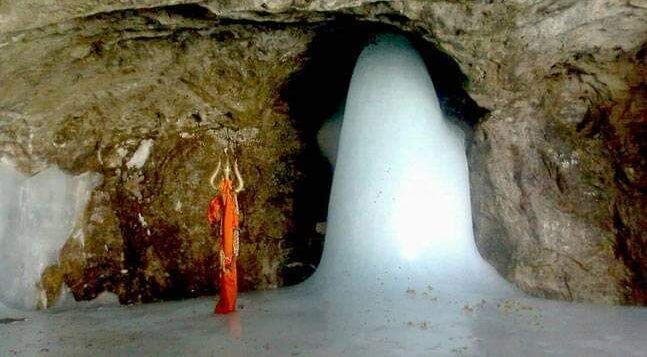
The Amarnath Cave is a natural limestone grotto that remains covered in thick snow for most of the year. Inside the cave, water droplets slowly trickle down from the mountain roof, freezing upon contact with the cold floor to form unique ice stalagmites:
- Swayambhu Shiva Lingam: The largest ice stalagmite represents Lord Shiva. It miraculously waxes and wanes in size according to the lunar cycle, reaching its full, solid-dome height on the full moon day of Shravan Purnima.
- The Shakti Peeth Pindi (Maa Mahamaya): Situated to the left of the main Shiva Lingam is a smaller, distinct ice stalagmite that represents Goddess Mahamaya. Devotees offer red draperies (Chunri) and vermilion here to seek her blessings of protection.
- Lord Ganesha Ice Lingam: A smaller ice stalagmite on the right represents Ganesha.
🚶 The Two Great Yatra Routes
Reaching this high-altitude cavern requires a rigorous trek through spectacular alpine valleys, meadows, and glaciers. There are two primary routes managed by the Shri Amarnathji Shrine Board (SASB):
1. The Traditional Pahalgam Route (Scenic & Gradual)
- Distance: Approximately
$43\text{ to }48 \text{ km}$from the Pahalgam base camp. - Trek Duration: Typically takes
$3\text{ to }5 \text{ days}$on foot or pony. - The Trail: Pahalgam
$\rightarrow$Chandanwari$\rightarrow$Pissu Top$\rightarrow$Sheshnag$\rightarrow$Panchtarni$\rightarrow$Holy Cave. - Why Choose This: The climb is gradual, allowing the body enough time to acclimatize and avoid high-altitude sickness (hypoxia). It is the most scenic route, taking you past stunning rivers, coniferous forests, and the emerald waters of Lake Sheshnag.
2. The Baltal Route (Short, Steep & Swift)
- Distance: Approximately
$14 \text{ km}$from the Baltal base camp. - Trek Duration: Can be completed in a single day (round-trip of
$8\text{ to }10 \text{ hours}$). - The Trail: Baltal
$\rightarrow$Domail$\rightarrow$Barari$\rightarrow$Sangam$\rightarrow$Holy Cave. - Why Choose This: Highly preferred by physically fit hikers, professionals, and those with time constraints. The trail is extremely steep, narrow, and challenging, requiring strong physical endurance.
🚁 Helicopter Services
For senior citizens, families, and differently-abled travelers, helicopter flights operate daily during the yatra season from both Pahalgam and Baltal to Panchtarni. From Panchtarni, the holy cave is a gentle $6 \text{ km}$ trek that can be completed on foot, horseback, or a palanquin (palki).
💡 Important Guidelines & Travel Tips for Pilgrims
- Mandatory Medical Certificate (CHC): Due to the high risk of altitude sickness and sub-zero temperatures, all pilgrims must obtain a Compulsory Health Certificate signed by an authorized government doctor before applying for the Yatra Permit online.
- Age Restrictions: Children under the age of
$13$, senior citizens above$75$, and pregnant women are strictly prohibited from undertaking this high-altitude trek. - Start Physical Training Early: Begin brisk walking, cardiovascular exercise, and deep-breathing exercises at least
$2\text{ to }3 \text{ months}$before the trip. - Pack Heavy Woolens: The weather in the Himalayas changes rapidly. Carry high-quality waterproof jackets, thermal inners, woolen socks, gloves, and sturdy trekking shoes with a deep rubber grip.
- Acclimatization is Key: If choosing the Baltal route, spend a night resting at the base camp to let your body adjust to the thin air before starting the steep climb.
🌸 Complete Your Sacred Himalayan Pilgrimage
Standing in front of the giant, cold limestone cave while watching the morning sun illuminate the natural ice shapes of Lord Shiva and Maa Mahamaya is an unforgettable experience. As the deep echoes of “Bala Jogi” and “Jai Kara” resound across the high mountain passes, a spiritual traveler feels a profound sense of absolute peace, resilience, and connection to the divine cosmos.
Are you planning to explore more iconic temples of Northern India? Read our ultimate hand-curated guides to the historic Shree Naina Devi Ji Temple in Bilaspur and the mystical Mata Chintpurni Devi Temple in Himachal Pradesh!