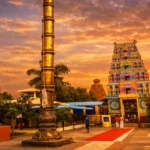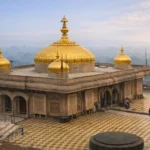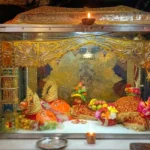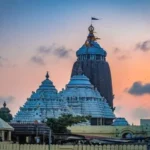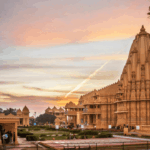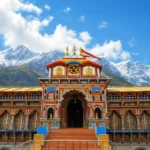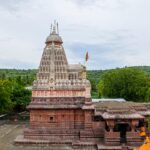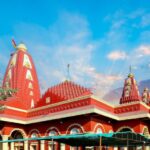
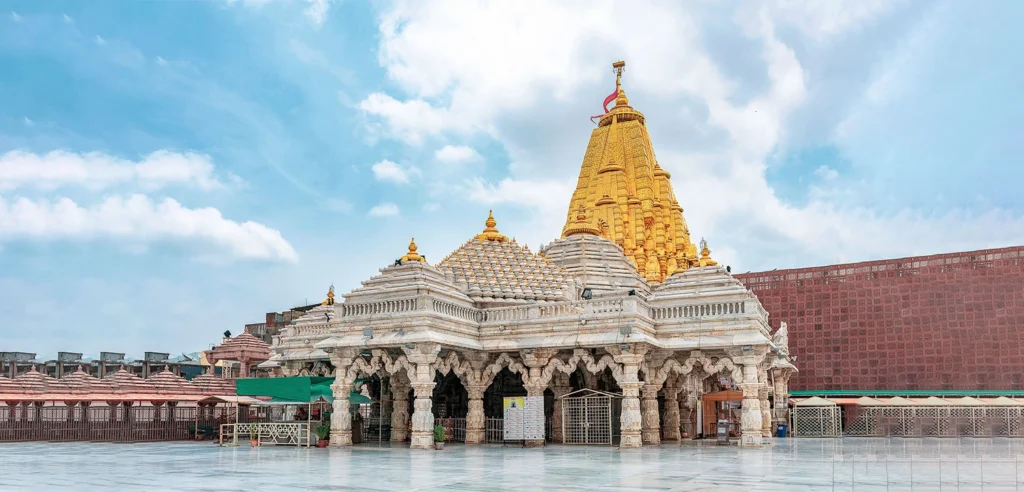
Situated beautifully in the scenic Arasur Hills of the ancient Aravalli mountain range in the Banaskantha district of Gujarat, the Ambaji Mata Temple (also known as Arasuri Amba Temple) is one of the most prominent, architecturally grand, and spiritually magnetic shrines in Western India. Located at an elevation of approximately $480 \text{ meters}$ ($1575 \text{ feet}$) above sea level, this historic temple sits near the Gujarat-Rajasthan border, close to the source of the mythological Vedic river Saraswati.
Celebrated as one of the major $51$ Shakti Peethas, Ambaji Temple does not house a traditional clay or stone idol of the Goddess. Instead, it is globally famous for the mystical worship of a sacred geometric copper plate called the Shree Visa Yantra.
Whether you are embarking on a sacred pilgrimage to seek the blessings of Maa Ambe, looking to ascend the legendary $999$ steps of the nearby Gabbar Hill, or riding the scenic cable car over the mountain ranges, this comprehensive guide has everything you need to plan your trip.
🛕 Ambaji Mata Temple: Quick Facts & Overview
| Aspect | Details |
|---|---|
| Primary Deity | Goddess Arasuri Amba (A powerful form of Adya Shakti) |
| Location | Ambaji Town, Banaskantha District, North Gujarat, India |
| Coordinates | $24.3300^\circ \text{N}, 72.8500^\circ \text{E}$ |
| Key Significance | The heart (or right arm) of Goddess Sati |
| Temple Altitude | $480 \text{ meters}$ ($1575 \text{ feet}$) above sea level |
| Main Temple Timings | $7:00 \text{ AM}$ to $11:30 \text{ AM}$, $12:30 \text{ PM}$ to $4:30 \text{ PM}$ & $6:30 \text{ PM}$ to $9:00 \text{ PM}$ |
| Entry Fee | Free |
| Gabbar Ropeway Fare | Approximately $₹125$ (Round trip for adults) | $₹70$ (Children) |
| Best Time to Visit | October to March (Cool mountain climate & Navratri celebrations) |
| Major Festivals | Bhadarvi Purnima Fair (September), Ashwin & Chaitra Navratras |
📜 The Sacred Legends of Arasuri Amba
The origin of Ambaji is steeped in rich Vedic mythology and epic tales of India.
1. The Fall of Sati’s Heart
According to the ancient Shiva Purana and Devi Bhagavata Purana, when Lord Shiva performed his cosmic dance of destruction (Tandava) carrying the lifeless body of Goddess Sati, Lord Vishnu dismembered her corpse into $51$ parts to save the universe. It is widely believed that Sati’s heart fell at the Arasur Hills, making Ambaji the supreme center of cosmic power (Hridaya Peeth).
2. The Mysterious Shree Visa Yantra
The most intriguing aspect of the Ambaji Temple is the absence of an idol. In the Garbhagriha (inner sanctum), there is a simple, highly revered gilded wall niche containing the Shree Visa Yantra.
- The Yantra: It is a gold-plated copper plate inscribed with sacred geometric figures and the syllable “Shree” in the center.
- The Blindfolded Worship: To maintain the extreme sanctity of the Yantra, photography is strictly prohibited. Even when the temple priests perform the daily rituals, they must tie a white cloth over their eyes to remain completely blindfolded. Devotees worship the Yantra from a distance.
- Three Daily Forms: The priests decorate the Yantra with gorgeous clothing, jewelry, and silver masks to present different forms (Darshans) of the Goddess throughout the day: Balyaroop (infant form) in the morning, Yauvanroop (youthful maiden) in the afternoon, and Praudhroop (mature maternal form) in the evening.
3. Connection to the Ramayana and Mahabharata
According to local lore, Lord Rama and Lakshmana visited the Arasur hills in search of Sita. Here, they prayed to Goddess Amba, who gifted Lord Rama a divine bow and arrow named Ajay, which he eventually used to defeat Ravana.
In the Mahabharata, it is said that the Pandavas spent their exile worshipping Maa Ambe, and Lord Krishna’s childhood hair-shaving ceremony (Chudakarma) was also performed at this holy hill.
🏔️ Gabbar Hill: The Original Abode of Maa Amba
Located just $1.5 \text{ km}$ from the main town temple, Gabbar Hill is considered the original seat of the Goddess. The steep, rocky hill features a sacred cave temple and is a major site of pilgrimage.
- The 999 Steps: Traditionally, energetic pilgrims climb
$999$paved stone steps to reach the hilltop shrine. The path is well-lit and lined with small stalls. - The Akhand Jyot: An eternal flame (Akhand Jyot) burns continuously inside the hilltop cave, symbolizing the eternal presence of the Divine Mother.
- The Footprints: The hilltop also features the symbolic footprints (Paduka) of Goddess Amba and her swing (Zula).
- The Light & Sound Show: In the evening, the entire hill serves as the canvas for a breathtaking, high-tech cultural laser light and sound show depicting local legends and the history of the Shakti Peethas.
🚠 Gabbar Hill Ropeway (Udankhatola)
For families, senior citizens, and differently-abled visitors, the modern ropeway system (officially named Maa Ambadevi Udan Khatola) makes the steep climb quick and effortless.
- The Ride: The cable cars cover a travel length of
$363 \text{ meters}$and ascend a vertical height of$138 \text{ meters}$in just$2 \text{ to } 3 \text{ minutes}$. - The Experience: The cabins offer stunning, bird’s-eye panoramic views of the rugged Aravalli range and the sprawling plains below.
- Operating Hours: Generally runs from
$7:00 \text{ AM}$to$7:00 \text{ PM}$daily.
🕰️ Daily Schedule & Ritual Timings
The daily schedule at Ambaji Temple changes slightly based on the seasons, but generally follows these standard timings:
- 7:00 AM to 11:30 AM: Morning Darshan (Mangal Aarti is performed at
$7:00 \text{ AM}$or$7:30 \text{ AM}$). - 11:30 AM to 12:30 PM: Temple gates close for bhog offerings.
- 12:30 PM to 4:30 PM: Reopens for afternoon darshan (Goddess is dressed in her youthful form).
- 4:30 PM to 6:30 PM: Temple gates close for resting and evening preparation.
- 6:30 PM to 9:00 PM: Reopens for evening darshan (Evening Aarti is performed at
$6:30 \text{ PM}$or$7:00 \text{ PM}$). - 9:00 PM: Temple Gates close for the night.
🗺️ How to Reach Ambaji Mata Temple
Ambaji is a major pilgrim town located in North Gujarat and is highly accessible by road and rail networks.
🚆 By Train (Easiest Option)
- Abu Road Railway Station (ABR): Located just
$20 \text{ km}$away in Rajasthan, this is the closest and most convenient railway station. It connects directly to major cities like Delhi, Mumbai, Jaipur, and Ahmedabad. You can easily find shared taxis, local state transport (GSRTC/RSRTC) buses, or private cabs outside the station. - Palanpur Junction Railway Station: Located roughly
$65 \text{ km}$away.
🚗 By Road
Ambaji is extremely well connected to major cities via smooth national and state highways:
- From Ahmedabad: Approximately
$185 \text{ km}$(about a$4 \text{ hours}$drive via NH 48). - From Udaipur (Rajasthan): Approximately
$157 \text{ km}$(about a$3 \text{ hours}$drive). - From Mount Abu: Located roughly
$45 \text{ km}$away (about a$1.5 \text{ hours}$drive).
✈️ By Air
- Sardar Vallabhbhai Patel International Airport, Ahmedabad (AMD): Located roughly
$184 \text{ km}$away. You can land in Ahmedabad and book a direct cab or board a luxury GSRTC bus directly to Ambaji.
💡 Essential Tips for First-Time Visitors
- Bhadarvi Purnima Fair: If you want to experience the spiritual energy of millions of walking pilgrims, visit during the mega Bhadarvi Purnima Fair in September. However, if you prefer a peaceful darshan, avoid this week as the town gets extremely crowded.
- Mansarovar Kund: Directly behind the main temple complex lies a large, historic rectangular water tank called Mansarovar. Devotees traditionally sprinkle its holy water on themselves before entering the temple.
- Pure Ghee Only: To maintain the absolute purity of the shrine, only pure cow ghee is permitted inside the temple premises for lighting lamps and preparing sweets.
- Combine with Polo Forest: If you are a nature lover, you can easily combine your pilgrimage with a scenic trip to the nearby historic ruins of Polo Forest or the cooler altitudes of Mount Abu.
🌸 Complete Your Grand Shakti Peeth Trail
From the spectacular white marble architecture of the temple spires to the mystical vibes of the blindfolded Yantra worship, a journey to Ambaji leaves your soul filled with immense strength, focus, and maternal warmth.
Are you preparing to discover more powerful temples in West Bengal and beyond? Check out our ultimate hand-curated guides to the sacred Tarapith Temple in Birbhum and the historic Kamakhya Devi Temple in Guwahati!