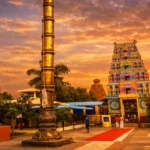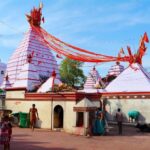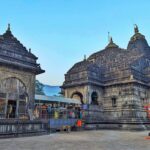
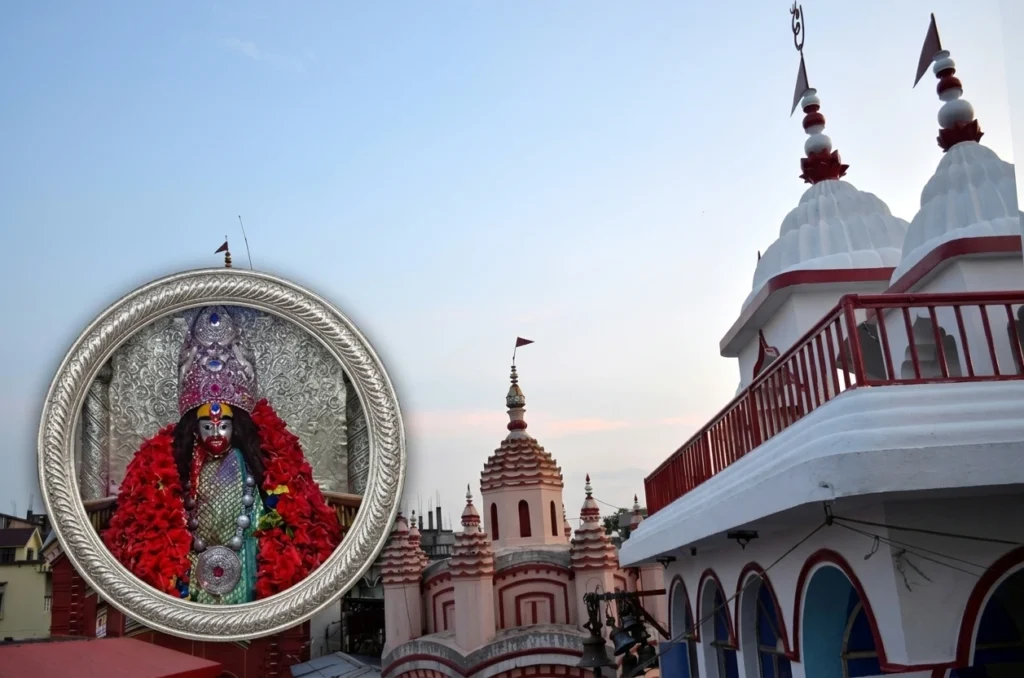
Situated quietly along the banks of the winding Dwarka River in the Birbhum district of West Bengal, the Tarapith Temple is one of the most prominent, mysterious, and spiritually powerful shrines in India. Located at an altitude of approximately $32 \text{ meters}$ ($105 \text{ feet}$) above sea level, this sacred site is celebrated as both an Adi Shakti Peeth and a supreme Maha Siddha Peeth—a place where spiritual seekers attain ultimate enlightenment and supernatural powers (Siddhis).
Dedicated to Goddess Tara, the second of the ten holy Mahavidyas (Goddesses of Great Wisdom), the temple represents a unique aspect of Shakti. Unlike other conventional shrines, Tarapith is world-famous for its powerful Tantric traditions, its ancient cremation ground (Mahasamsan) where rituals are performed to this day, and the legacy of the legendary mystic saint Sadhak Bamakhepa.
Whether you are looking to immerse yourself in the deep mystical energies of Tantra, witness the unique double-idol of Mother Tara, or seek blessings for a worry-free life, this comprehensive guide has everything you need to plan your pilgrimage.
🛕 Tarapith Temple: Quick Facts & Overview
| Aspect | Details |
|---|---|
| Primary Deity | Maa Tara (A powerful, compassionate manifestation of Shakti) |
| Location | Tarapith, Birbhum District, West Bengal, India |
| Coordinates | $24.1131^\circ \text{N}, 87.7965^\circ \text{E}$ |
| Key Significance | The third eye (or eyeball) of Goddess Sati; Tara translates to eyeball |
| Associated Bhairav | Chandabhairav (and spiritually Bamakhepa as Mahakala Bhairava) |
| Temple Altitude | $32 \text{ meters}$ ($105 \text{ feet}$) above sea level |
| Timings (Daily) | $5:30 \text{ AM}$ to $10:00 \text{ PM}$ (Briefly closes around $12:00 \text{ PM}$ to $1:30 \text{ PM}$) |
| Entry Fee | Free (VIP Darshan passes are available at $₹500$) |
| Best Time to Visit | October to March (Pleasant weather & Kaushiki Amavasya celebrations) |
| Major Festivals | Kaushiki Amavasya (August-September), Kali Puja, Durga Puja |
📜 The Sacred Legends of Maa Tara at Tarapith
The origin of Tarapith is steeped in two major Hindu legends that highlight her dual identity as a fierce protector and a nurturing cosmic mother.
1. The Fall of Sati’s Third Eye (Eyeball)
According to the ancient Shakti Peetha Stotram, when Lord Shiva performed his dance of cosmic destruction (Tandava) carrying Sati’s charred body, Lord Vishnu dismembered her corpse into $51$ parts. It is believed that Sati’s eyeball or third eye fell at this exact location. In Bengali, the word for eyeball or pupil is “Tara”, giving this sacred village its eternal name—Tarapith.
2. The Nurturing Mother of Lord Shiva
During the epic Samudra Manthan (churning of the ocean), a deadly poison named Halahala emerged, threatening to destroy the universe. To protect creation, Lord Shiva consumed the poison, which turned his throat blue and caused a burning, excruciating pain.
To soothe him, Goddess Sati manifested in her compassionate form of Maa Tara and breastfed Lord Shiva. This divine act neutralized the poison. Thus, Maa Tara is worshipped here as a motherly savior who relieves all forms of suffering and spiritual toxicity.
3. Sage Vashistha’s Vision
According to oral traditions, the great sage Vashistha (one of the Saptarishis) practiced extreme penance at Tarapith to please Maa Tara but initially failed. On the advice of a divine voice, he went to Tibet to meet Lord Buddha, who instructed him to worship the Goddess using left-handed Tantric practices (Vamachara).
Vashistha returned to Tarapith, chanted the Tara-mantra $300,000$ times, and finally received her darshan. At his request, the Goddess turned into a stone deity depicting her motherly form, which is housed inside the sanctum today.
👁️ The Unique and Mystic Tara Idol
The deity inside the Garbhagriha (inner sanctum) holds a mystical secret:
- The Primordial Stone Idol: The original, self-manifested stone idol (Pindi) depicts Maa Tara in her gentle form, suckling a baby Lord Shiva. To protect its sacredness, this stone image is kept completely covered and is not visible to general devotees.
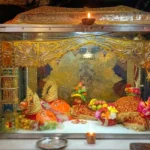
- The Outer Metal Image: Over the stone Pindi, priests have placed a majestic,
$3 \text{ feet}$high metal idol of Maa Tara in her fierce form. This visible idol has four golden arms, wears a garland of skulls, and has her tongue sticking out. She wears a silver crown with flowing hair and is shaded by a beautifully carved silver umbrella.
🏔️ Bamakhepa: The “Mad” Saint of Tarapith
No guide to Tarapith is complete without mentioning Sadhak Bamakhepa ($1837\text{--}1911$), also known as the “mad saint.”
Bamakhepa spent his entire life in the adjoining Tarapith cremation ground, meditating under the guide of Kailashpati Baba. He was so deeply intoxicated with love for Maa Tara that he treated her as his biological mother, often crying out to her and feeding her his own food before offering it to the temple.
Considered an incarnation of Lord Shiva as Mahakala Bhairava, Bamakhepa attained high spiritual siddhis. Today, his ashram sits very close to the temple, and devotees traditionally pay respects at his temple and samadhi site to make their pilgrimage complete.
🕰️ Daily Schedule & Ritual Timings
The daily rituals at Tarapith are highly vibrant and filled with the intense aroma of incense and red hibiscus garlands.
- 5:30 AM: Temple Gates Open & Mangal Aarti.
- 6:00 AM to 12:00 PM: Morning Darshan and general puja offerings.
- 12:00 PM to 1:30 PM: Temple gates close for the royal midday Bhog offering (which includes traditional fish and rice offerings).
- 1:30 PM to 7:00 PM: Reopens for afternoon darshan.
- 7:30 PM: Sandhya Aarti (Evening Aarti) accompanied by the intense beating of drums (Dhak) and brass bells.
- 10:00 PM: Temple Gates close for the night.
🗺️ How to Reach Tarapith Temple
Tarapith is a well-connected town located in the green plains of Birbhum, approximately $264 \text{ km}$ north of Kolkata.
🚆 By Train (Fastest Option)
- Rampurhat Junction (RPH): This is the nearest major railway station, located just
$9 \text{ to } 10 \text{ km}$away from the temple. Countless superfast and express trains run daily from Howrah, Sealdah, and Kolkata. You can easily find shared auto-rickshaws, local buses, or private cabs outside the station. - Tarapith Road Railway Station: Located roughly
$5 \text{ km}$from the temple, primarily served by local passenger trains.
🚗 By Road
Tarapith is extremely well connected to major cities in West Bengal via a smooth highway network:
- From Kolkata: Approximately
$264 \text{ km}$(about a$5\text{ to }6 \text{ hours}$drive via NH 19 and Panagarh-Morgram highway). Regular luxury AC state and private buses operate daily from Esplanade (Kolkata). - From Bolpur (Shantiniketan): Located roughly
$80 \text{ km}$away (approx.$2 \text{ hours}$drive).
✈️ By Air
- Kazi Nazrul Islam Airport, Durgapur (RDP): Located about
$120 \text{ km}$away. - Netaji Subhash Chandra Bose International Airport, Kolkata (CCU): Located roughly
$250 \text{ km}$away. You can land in Kolkata and easily hire a rental taxi or board a train to Rampurhat.
💡 Essential Tips for First-Time Visitors
- Visiting the Cremation Ground (Mahasamsan): The adjacent cremation ground is highly revered. While safe to visit during the day, please be deeply respectful of families performing last rites and avoid taking photographs or recording videos.
- Holy Dip in Jibita Kunda: Right next to the temple lies a sacred water tank called Jibita Kunda (the Living Pond). Devotees believe its water has profound healing properties.
- Beware of Touts: You may be approached by local priests (Sebayets) promising fast-track entry inside the sanctum. If you want to skip the general queue (which can take
$3 \text{ to } 4 \text{ hours}$on weekends), you can officially buy a VIP Darshan ticket at the designated temple counters for$₹500$. - Navratri and Amavasya: Visiting during Kaushiki Amavasya is highly auspicious, but it attracts millions of pilgrims. If you prefer a peaceful visit, plan your trip during weekdays in November or December.
🌸 Embark on Your Supreme Tantric Pilgrimage
From the fiery red vermilion applied to your forehead by the priests to the hauntingly beautiful evening aarti echoing across the Dwarka River, a journey to Tarapith leaves you with an unforgettable spiritual experience. It is a sanctuary where the boundaries of life, death, and divine love dissolve in the maternal embrace of Maa Tara.
Are you preparing to discover more powerful temples in West Bengal and beyond? Check out our ultimate hand-curated guides to the sacred Kalighat Kali Temple in Kolkata and the historic Dakshineswar Kali Temple!