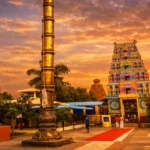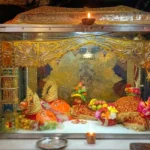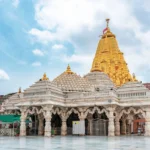
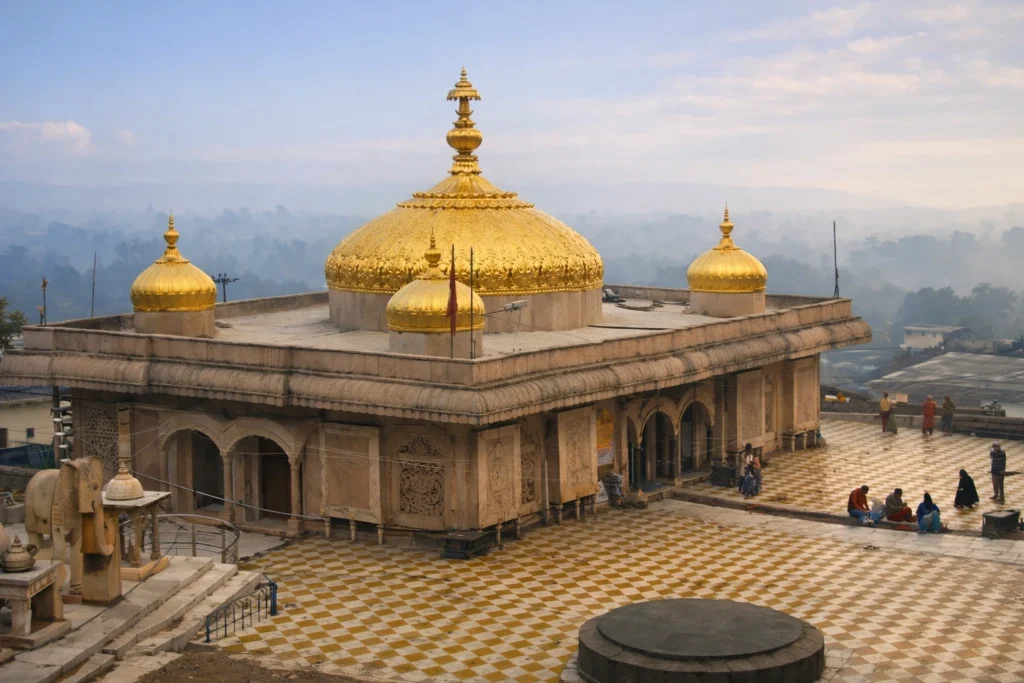
The Jwalamukhi Devi Temple, nestled in the scenic Beas Valley of the Kangra district in Himachal Pradesh, is one of the most enigmatic and spiritually revered shrines in India. Unlike most Hindu temples that house traditional stone or metal idols, Maa Jwalamukhi is worshipped here in her formless, elemental state—manifested as nine natural, perpetual blue flames erupting directly from the crevices of a solid rock cliff.
🔥 Jwalamukhi Devi Temple: Quick Facts & Overview
| Aspect | Details |
|---|---|
| Primary Deity | Goddess Jwalamukhi (The Deity of the Flaming Mouth) |
| Location | Kangra Valley, Himachal Pradesh, India |
| Key Significance | One of the major $51 \text{ Shakti Peethas}$ (Sati’s tongue fell here) |
| Temple Architecture | Indo-Sikh architectural style with a gilded golden dome |
| Form of Worship | Nine natural, burning flames (No physical idol is present) |
| Major Festivals | Chaitra Navratri, Ashwin Navratri |
| Best Time to Visit | September to March (pleasant weather and vibrant festivals) |
⚡ Quick Read: Essential Highlights
- The Legend: According to sacred Puranas, this temple marks the spot where Sati’s tongue fell. The nine eternal flames represent the nine forms of Goddess Durga.
- The Natural Mystery: The blue flames burn continuously without any known source of natural gas, fuel, or oil, baffling modern geologists for decades.
- The Imperial Test: History records that the Mughal Emperor Akbar tried to extinguish the sacred flames by flooding them with water, only to fail and eventually walk up the mountain barefoot to offer a golden parasol (Chhatra) in repentance.
- The Royal Patronage: Maharaja Ranjit Singh of Punjab paid homage to the temple in
$1815$, gilding the main dome with pure gold to celebrate the power of the Goddess.
📜 Sacred Legends & The Nine Eternal Flames
The history and worship of Jwalamukhi Devi are deeply rooted in the cosmic destruction of Daksha’s sacrifice and the divine manifestation of the Adi Shakti.
1. The Fall of Sati’s Tongue
During the cosmic event where Lord Vishnu used his Sudarshana Chakra to cut the body of Goddess Sati to pacify Lord Shiva’s grief, Sati’s tongue fell at this exact location in the Kangra Valley. The tongue immediately manifested as raging, divine fire. Thus, the Goddess is worshipped as Jwalamukhi (the one with the flaming mouth), and the Bhairav associated with this Peetha is revered as Unmatta Bhairav.
2. The Nine Flames of Maa Durga
Devotees worship nine distinct natural flames within the inner sanctum, each representing a unique aspect of the Divine Mother:
- Mahakali: The primary, most powerful flame representing change and time.
- Maa Annapurna: The flame that grants food, nourishment, and prosperity.
- Maa Chandi: The flame representing power and victory over evil.
- Maa Hinglaj: The flame representing the healing and life-giving force.
- Maa Vindhyavasini: The flame associated with absolute spiritual liberation.
- Maa Mahalakshmi: The flame that blesses devotees with wealth and success.
- Maa Saraswati: The flame representing knowledge, wisdom, and arts.
- Maa Ambika: The flame representing maternal love and protection.
- Maa Anjana: The flame associated with strength, health, and vitality.
🏛️ Historical Accounts: Akbar’s Defeat and Ranjit Singh’s Gold
The temple has stood as an unshakeable symbol of faith, surviving attempts by foreign rulers to test or destroy its miraculous nature.
The Legend of Emperor Akbar
During the peak of the Mughal Era, Emperor Akbar heard tales of a temple in the hills of Kangra where fire burned without fuel. Skeptical of this miracle, he marched his army to the temple. Akbar ordered his men to cover the flames with massive iron sheets and canalized mountain stream water directly over the crevices to douse the fire.
To his astonishment, the flames burst through the water and iron sheets, burning brighter than before. Recognizing the divine power of Maa Jwalamukhi, Akbar traveled to the temple barefoot, carrying a massive umbrella made of gold as an offering. However, legend states that because of his initial pride, the Goddess rejected the offering: the golden parasol instantly transformed into an unknown, dull metal upon being placed in the temple, a material that modern scientists still cannot identify.
The Contribution of the Sikh Empire
The temple’s magnificent visual profile is credited to Maharaja Ranjit Singh and his son, Kharak Singh. In $1815$, following his victories, Maharaja Ranjit Singh visited the shrine and gifted a heavy, beautifully crafted gold plate to cover the main dome. Kharak Singh later gifted the silver-plated folding doors that welcome pilgrims into the Garbhagriha (inner sanctum) today.
🚶 How to Reach Jwalamukhi Devi Temple
The temple is located in the lower Himalayas of Himachal Pradesh and is highly accessible via multiple scenic routes.
By Road
The town of Jwalamukhi is well-connected by state highway networks.
- From Dharamshala: Approximately
$55 \text{ km}$(about$1.5\text{ to }2 \text{ hours}$drive). - From Kangra Town: Approximately
$35 \text{ km}$(about$1 \text{ hour}$drive). - Regular direct buses ply from major neighboring cities including Pathankot, Hoshiarpur, Chandigarh, and Shimla.
By Train
- Nearest Broad Gauge Station: Pathankot Railway Station, located about
$115 \text{ km}$away. From there, you can hire local taxis or take a bus. - Narrow Gauge (Toy Train): The nearest narrow gauge station is Jawalaji Road Station, located
$20 \text{ km}$from the temple, offering a slow but beautiful mountain train journey.
💡 Important Pilgrimage & Darshan Guidelines
Make the most of your spiritual visit with these simple guidelines:
- Sneh Arti: Try to witness the grand Aarti sessions, especially the evening Shayan Aarti, where the deity is offered beautiful silk robes and spiritual chants fill the air.
- Offerings: Devotees traditionally offer Rabri (sweetened condensed milk), coconut, and seasonal fruits to the sacred flames.
- Photography: Photography inside the inner sanctum containing the sacred flames is strictly prohibited to maintain the sanctity of the shrine.
🌸 Embrace the Mystic Warmth of Jwalamukhi
To sit quietly in the courtyard of Jwalamukhi Temple, watching the blue-gold flames dance naturally against the ancient dark stones, is an experience that bridges the gap between natural wonder and absolute spiritual truth. The divine heat of this eternal Shakti Peetha warms the soul and leaves every pilgrim with a lingering sense of awe, peace, and protection.
Looking to explore more sacred shrines in the Kangra valley? Read our ultimate step-by-step guides to the highly revered Chamunda Devi Temple in Kangra and the beautiful Naina Devi Temple in Himachal Pradesh!