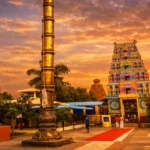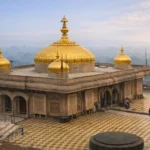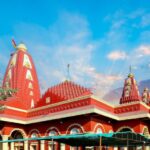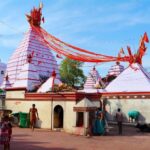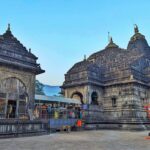
Nestled peacefully in the lush green valleys of the Una district in Himachal Pradesh, the Mata Chintpurni Devi Temple is one of the most powerful and highly revered shrines in Northern India. Situated at an altitude of approximately $977 \text{ meters}$ ($3205 \text{ feet}$) above sea level on the scenic Sola Singhi ridge of the Shivalik Himalayas, this sacred site is celebrated as the spot where the worries and anxieties of devotees are completely wiped away.
Indeed, the name “Chintpurni” translates literally to “the one who fulfills all wishes and dispels all worries” (Chinta meaning worry, and Purni meaning fulfiller).
As one of the prominent 51 Shakti Peethas, the temple is also famously known as Chinnamastika Dham. Whether you are a dedicated pilgrim seeking the motherly grace of Maa Chintpurni or a traveler exploring the divine mountain trails of Himachal, this comprehensive guide has everything you need.
🛕 Mata Chintpurni Temple: Quick Facts & Overview
| Aspect | Details |
|---|---|
| Primary Deity | Goddess Chintpurni / Maa Chhinnamastika |
| Location | Una District, Himachal Pradesh, India |
| Coordinates | $31.8086^\circ \text{N}, 76.1028^\circ \text{E}$ |
| Key Significance | Soles of the feet (or forehead) of Goddess Sati |
| Temple Altitude | $977 \text{ meters}$ ($3205 \text{ feet}$) |
| Timings (Summers) | 4:00 AM to 10:00 PM |
| Timings (Winters) | 5:30 AM to 9:30 PM |
| Entry Fee | Free |
| Best Time to Visit | March to October (Pleasant weather) |
| Major Festivals | Sawan Ashtami (July-August), Chaitra & Ashwin Navratras |
📜 The Sacred Legends of Mata Chintpurni
The temple’s origins are deeply rooted in profound mythological stories of ultimate sacrifice and unwavering devotion.
1. The Fall of Sati’s Feet
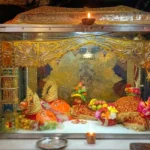
According to the ancient Shiva Purana, when Lord Shiva performed the cosmic dance of destruction carrying the charred body of Goddess Sati, Lord Vishnu severed her body into 51 pieces using his Sudarshan Chakra. It is widely believed that the soles of Goddess Sati’s feet fell at the exact spot where the temple stands today. The goddess is worshiped here in the form of a holy, rounded stone Pindi.
2. The Headless Goddess: Chhinnamastika
Mata Chintpurni is also revered as Maa Chhinnamastika (“the headless one”).
According to the Markandeya Purana, after defeating a series of powerful demons in a fierce cosmic battle, Goddess Durga’s two companions, the yoginis Jaya and Vijaya, remained intensely thirsty for more blood. To satisfy their hunger and save the cosmic order, the compassionate Goddess severed her own head.
She is depicted holding her own head, with three streams of blood spurting from her neck—one stream flowing into her own severed mouth and the other two feeding Jaya and Vijaya. This fierce form symbolizes extreme self-sacrifice, the cutting away of the human ego, and the ultimate transcendence of mortal limits.
3. The Vision of Pandit Mai Das
According to local history, the temple was established about 26 generations ago by a deeply spiritual Saraswat Brahmin named Pandit Mai Das of Chhaproh village.
While traveling, Mai Das stopped to rest under a large banyan tree on the hilltop. He heard beautiful, celestial music and fell asleep. In his dream, Goddess Durga appeared and revealed that she resided at that very spot in the form of a Pindi. She instructed him to build a temple. Mai Das dedicated his entire life to her service, and to this day, his direct descendants continue to serve as the official head priests of the Chintpurni temple.
🛡️ The Protective Shield of Lord Shiva
An extraordinary feature of Chintpurni is its spiritual geometry. According to local scriptures, Lord Shiva protects Maa Chhinnamastika from all four cardinal directions.
There are four ancient Shiva temples situated almost equidistant from Chintpurni, acting as a divine shield:
- Kaleshwar Mahadev in the East
- Narayhana Mahadev in the West
- Muchkund Mahadev in the North
- Shiva Bari Temple in the South
It is considered highly auspicious for pilgrims to pay their respects at these Shiva temples during their journey.
🕰️ Daily Schedule & Ritual Timings
Plan your day to experience the mesmerizing morning or evening prayers.
- 4:00 AM (Summers) / 5:30 AM (Winters): Temple Gates open.
- 6:00 AM: Morning Mangal Aarti.
- 12:00 PM to 12:30 PM: Midday Bhog offering (gates close briefly).
- 8:00 PM: Evening Sandhya Aarti.
- 10:00 PM (Summers) / 9:30 PM (Winters): Temple gates close.
Note on Offerings: Devotees traditionally offer a special package of seven pieces of betelnut (supari), a red flag (dhwaja), and a coconut, bound together with a sacred multi-colored thread (Mauli).
🗺️ How to Reach Chintpurni Devi Temple
The temple is located on the boundary of Punjab and Himachal Pradesh, making it highly accessible.
🚆 By Train (Most Convenient)
- Amb Andaura Railway Station (AADR): The closest railway station, located just 20 km away from Chintpurni. Many direct trains from Delhi and Punjab halt here.
- Una Himachal Railway Station: Situated about 50 km from the temple. You can easily find local state buses and direct taxis outside both stations.
✈️ By Air
- Gaggal Airport, Kangra (Dharamshala): Located 60 km away.
- Shaheed Bhagat Singh International Airport, Chandigarh: Located roughly 150 km away.
🚗 By Road
Chintpurni is situated along the national highway (NH 503) connecting Hoshiarpur and Dharamshala.
- From Delhi: Approximately $420 \text{ km}$ (approx. 8 hours drive).
- From Jalandhar: About $90 \text{ km}$ (approx. 2 hours drive).
- From Dharamshala: Approximately $130 \text{ km}$ (approx. 3 hours drive).
Note: Private vehicles are allowed up to the main parking area near the bus stand. From there, pilgrims walk a gentle 1.5 km pathway lined with traditional sweet shops up to the main temple complex.
💡 Essential Tips for First-Time Visitors
- The Wish-Fulfilling Banyan Tree: Inside the temple courtyard stands an ancient, massive banyan tree. It is a sacred tradition to tie a red string (Kalava) on its branches while making a wish. Once your wish is granted, pilgrims return to untie a string as a sign of gratitude.
- Mundan Ceremony: The temple complex is a highly popular site for performing the Mundan (the auspicious first hair-cutting ceremony of a child).
- Beware of Monkey Troubles: Just like other hill shrines in Himachal, be careful of the local monkeys. Avoid carrying food items openly in plastic bags.
🌸 Complete Your Himalayan Shakti Trail
The peaceful chants of “Jai Mata Di,” the ringing of brass bells, and the misty mountain wind make a trip to Chintpurni an unforgettable soul-stirring experience. Standing before the sacred Pindi inside the marble courtyard, you truly feel a wave of peace washing over your mind.
Want to expand your pilgrimage through the sacred hills of Himachal Pradesh? Read our complete travel guides to the breathtaking Shree Naina Devi Temple and the legendary Kamakhya Devi Temple in Assam!